Autoimmune Disorder Tests in Thane
Autoimmune disorders can affect multiple organs and tissues, sometimes causing symptoms that are difficult to identify in the early stages. Conditions such as lupus, rheumatoid arthritis, and autoimmune thyroid disease may require specific laboratory investigations to determine whether the immune system is reacting against the body’s own cells.
Established in 1979 by Dr. Ulhas Mohan Vaidya, Dr. Vaidya’s Laboratory offers specialised diagnostic services supported by experienced professionals, modern laboratory systems, and quality-focused testing processes. The laboratory assists doctors and patients in evaluating suspected autoimmune conditions.
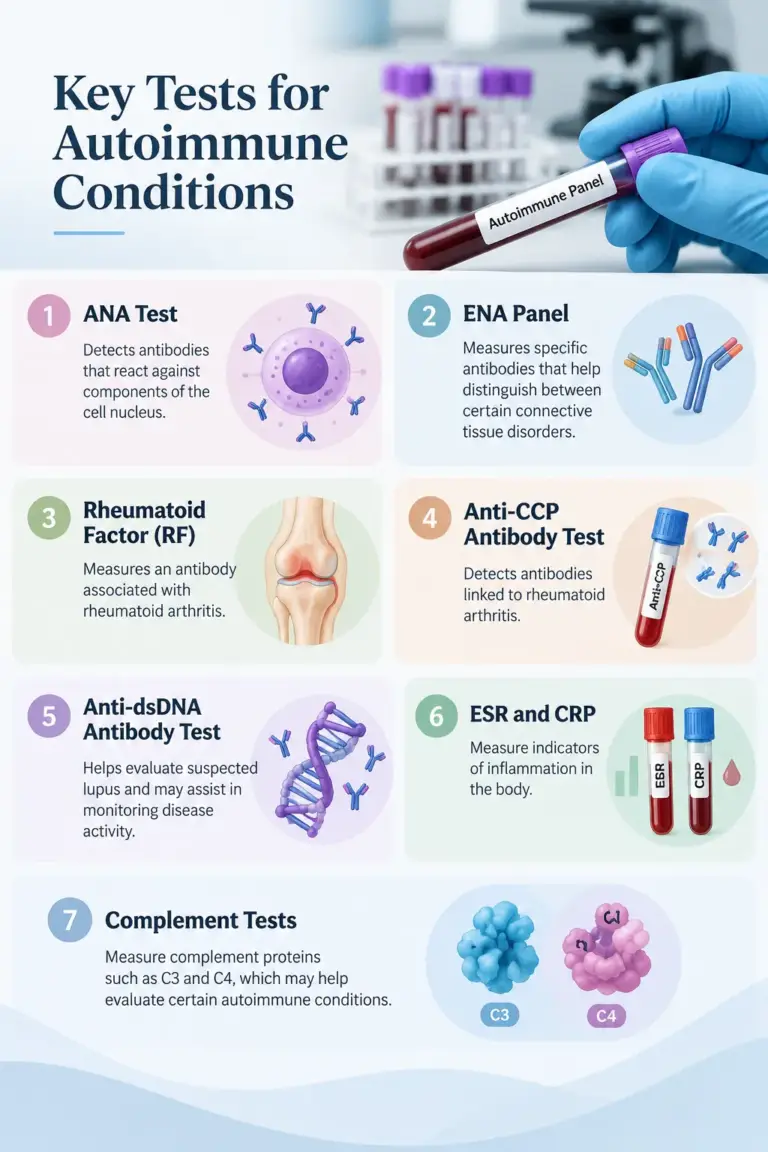
Dr. Vaidya’s Lab offers Autoimmune Disorder Tests in Thane, including ANA testing, disease-specific antibody investigations, and inflammatory marker tests based on clinical requirements. These investigations provide valuable information that doctors interpret alongside symptoms, medical history, and other findings to guide further evaluation and care.
Which Tests Are Used to Detect Autoimmune Disorders?
There isn’t a single test for all autoimmune diseases. Various tests are suggested according to symptoms, affected organs, medical history and initial examination findings.
Some other tests performed include tests for thyroid antibodies, disease-specific antibodies, CBC, kidney function tests, and urinalysis. The appropriate Autoimmune Blood Test depend on the disease being investigated.
Get clarity on the tests needed for your health concerns.
Connect with a healthcare professional for suitable testing guidance.
Which tests are linked to different autoimmune conditions? Let’s understand the common testing options.
Common Autoimmune Disorders and Their Related Tests
Different autoimmune conditions require different investigations. Doctors may use one test or a combination of tests to assess the underlying cause of symptoms.
| Suspected condition | Tests that may be recommended |
| Systemic lupus erythematosus | ANA, anti-dsDNA, ENA, C3 and C4 |
| Rheumatoid arthritis | Rheumatoid factor, anti-CCP, ESR and CRP |
| Sjögren’s syndrome | ANA, anti-SSA/Ro and anti-SSB/La |
| Autoimmune thyroid disease | Anti-TPO and anti-thyroglobulin antibodies, with thyroid function tests |
| Coeliac disease | Tissue transglutaminase IgA and total IgA |
| Autoimmune hepatitis | ANA, anti-smooth muscle antibodies, and liver function tests |
These are examples rather than a fixed testing panel. Not every patient needs every investigation, and some conditions require additional assessments or specialist evaluation.
Are persistent symptoms raising concerns about your health? Let’s identify when autoimmune testing may be considered..
When May Autoimmune Disorder Testing Be Recommended?
Autoimmune testing may be recommended if there are chronic symptoms that cannot be explained or if clinical signs show that the immune system might be attacking healthy tissues.
An autoimmune assessment may be considered in cases involving:
These symptoms may have different causes and don’t always mean an autoimmune disease.

Preparing for an autoimmune blood test? Let’s review the essential steps before sample collection.
How to Prepare for Autoimmune Disorder Tests
Most autoimmune blood tests require little preparation, although requirements vary depending on the investigation.
ANA testing generally does not require fasting, but other tests ordered alongside it may have specific instructions.
Inform the healthcare
professional about medications: Some medicines and supplements can affect particular test results.
Carry previous reports
Earlier blood tests and medical records can help with comparisons and further evaluation.
Confirm any specific requirements with the laboratory before your visit.
Share relevant health information
Mention existing diagnoses, symptoms, and ongoing treatment when discussing the test with your doctor.
Following these instructions helps ensure appropriate sample collection and interpretation.
How Are Autoimmune Test Results Interpreted?
Interpretation of autoimmune test results has to be done in the context of patient’s symptoms, medical history, examination findings and other investigations done.
A positive result for ANA or another antibody test does not automatically mean that the patient is suffering from an autoimmune disease because some healthy people can have autoantibodies. Likewise, a negative result does not rule out all autoimmune diseases.
The physician may take into account antibody levels, patterns in the tests, inflammatory markers, organ function results, and other tests for confirming the diagnosis. More tests may be necessary if the results are inconclusive.
Dr. Vaidya’s Laboratory provides diagnostic testing services to support clinical evaluation. Final diagnosis and treatment decisions should be made by the treating healthcare professional.

Understand your reports in the context of your health.
Get in touch with a qualified doctor for appropriate interpretation. For additional information, refer to the MedlinePlus guide to autoimmune antibody testing.
Frequently Asked Questions
They are laboratory investigations that aid in detecting antibodies, inflammation, and other changes that are usually associated with suspected autoimmune conditions.
Dr. Vaidya’s Laboratory offers specialised diagnostic services in Thane. Contact the laboratory to confirm the availability of your prescribed autoimmune investigations.
This test helps detect antinuclear antibodies in the blood and is usually performed when there is suspicion of certain autoimmune conditions.
Not necessarily. There are several reasons why a test may give a positive result and this should be interpreted along with symptoms, medical history, and other test findings.
Rheumatoid factor and anti-CCP antibody blood tests might be recommended among other tests.
Genetic factors might increase your chance of getting an autoimmune disease, but it does not mean that you will necessarily have one because of your family history.
Disclaimer: The information shared in this content is for educational purposes and not for promotional use.